Let us open this space with an observation that underlies many of the assumptions we carry—often without consciously realizing it—about bodies, health and the ways we care for ourselves while navigating deep physiological transitions.
It’s something we notice on yoga mats, in wellness spaces, through social media and in the lives of those around us: Your practice, lifestyle, diet and all the rest do not look quite like mine.
This moment of comparison gives us pause—and often prompts uncertainty about which one of us is doing it right.
Almost every source of information we are exposed to implies that there is a correct way—and a wrong way—to care for the body. Even when those sources rarely agree, and their messages shift from day to day, we are often left with the quiet conclusion that we’re still doing it all wrong.
This is especially true when our own rhythms, needs and capacities don’t match what is most often modeled around us. In these moments, difference can start to feel like deviation rather than diversity of experience.
But what if variation is not a sign that we are veering from a norm, but is rather a clue that context matters? The body responds not to a set of ideals, but is exquisitely designed to adapt to circumstances—history, environment, timing, capacity, present conditions, and moment-to-moment needs.
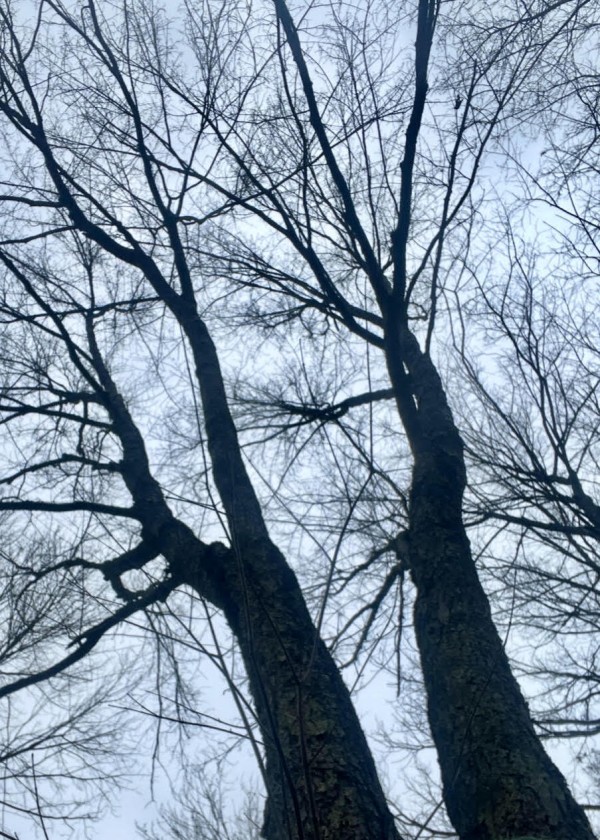
A tree rich with foliage sheds its leaves in autumn. Newly exposed, it draws inward and downward to face the colder, harsher conditions of winter.
Bodies, too, reorganize in response to changing conditions. As a result, the same food or movement practice that feels nourishing and energizing in summer may feel draining and depleting in winter.
This is true not only across seasons, but across bodies as well. A practice that is nourishing and energizing for one person may be draining and depleting for another. Yet if the second person moved through the same practice more slowly, with more easeful transitions and in a warmer environment, she might experience those same benefits as well.
When we ignore context, we risk misinterpreting difference for error.
Context shapes the lens through which we view the world and navigate our lives. When we learn to observe greater nuance—both in the external environment and within ourselves—our perspective broadens, inviting greater clarity, compassion and choice.
This library is a space to explore what emerges when simple explanations for what we sense in our bodies fall short—especially when variation in experience is used to discount lived reality. It addresses questions we might not have known how to ask or where to ask them. Here, we can begin to redefine what it means to live well as health unfolds in unexpected ways.